Contemporary Challenges in Holocaust and Anti-Semitism Education—Presentation of a Multimedia Toolkit
We invite you to the event titled “Contemporary Challenges in Holocaust and Anti-Semitism Education—Presentation of a Multimedia Toolkit,” will take place on Monday, August 24, 2026, at the Narutowicz Institute’s Educational Center in Warsaw (20 Andersa St.) from 10:00 a.m. to 3:00 p.m.
We invite you to the event titled “Contemporary Challenges in Holocaust and Anti-Semitism Education—Presentation of a Multimedia Toolkit,” will take place on Monday, August 24, 2026, at the Narutowicz Institute’s Educational Center in Warsaw (20 Andersa St.) from 10:00 a.m. to 3:00 p.m.
This time, we invite you to participate in a training session and exchange of experiences, which mark the culmination of a project focusing on memoir literature addressing difficult topics and its role in education aimed at reducing antisemitism.
We invite you—educators—to join us, as we want to ensure that the lesson plans we are developing for students on antisemitism, the Holocaust, and remembrance fully meet the needs of classroom instruction and workshops.
Event schedule:
10:00–10:30 – Registration, welcome, coffee, introduction to the meeting – project context
10:30 a.m.–12:45 p.m. – Presentation of a multimedia educational kit – “Materials in Practice” workshop session in two parts (2 x 60 min) – 4 groups to choose from (participants may join two groups):
Group 1: Memoir Literature in School – presentation of lesson plans based on the books *Was I Afraid of Death?* by Hedi Fried (identity, the rise of discrimination) and *The Girl from the Closed City* by Larissa Cain (Life Before the War, In Hiding, In the Ghetto, After the War) (Mariusz Sokołowski)
Group 2: Sources: the ghetto experience, difficult questions, moral dilemmas (Robert Szuchta)
Group 3: Historical empathy, psychological challenges (Alicja Kotowska)
Group 4: Multimedia and new technologies—presentation of the podcast “Voices of Memory” and the “Learning from History” website (Agnieszka Kudełka)
12:45 – 1:45 Lunch break
1:45 – 2:45 p.m. Panel discussion: “How to integrate Holocaust education with civic and anti-discrimination education?” – guests: Bartosz Duszyński (Forum for Dialogue), Wiesława Młynarczyk (Warsaw Ghetto Museum), Katarzyna Suszkiewicz (Galicia Jewish Museum), Tathalia Tkaczenko (Auschwitz-Birkenau Memorial and Museum), Piotr Trojański (Institute of History and Archival Science at the University of the National Education Commission in Kraków) – TBC
2:45 PM – 3:00 PM Summary and survey
Link to register for the event: https://forms.gle/ickoKtbQDhXpqTZz7
Your experience is invaluable to us, so we hope to see a large turnout once again (we expect at least 25 participants from Poland and Lithuania).
See you there!
The KARTA Center Team and partners
Event within the program—“Education Against Antisemitism. Learning from the Past to Understand Contemporary Challenges. A Multimedia Educational Kit.”
Funded by the EU. The views and opinions expressed are solely those of the author(s) and do not necessarily reflect the views and opinions of the European Union or the European Education and Culture Executive Agency (EACEA). Neither the European Union nor the EACEA is responsible for them.
Hasła z glosariusza
We invite you to participate in the testing phase of our educational materials!
You can get free copies of 2 publications and gather great experience!
We invite you to participate in the practical component of the project titled “Education Against Antisemitism: Learning from the Past to Understand Contemporary Challenges.” This multimedia educational kit is designed to help you conduct workshops based on lesson plans developed by educators—at your school, library, or memorial site.
We will send one copy each of Larissa Cain’s *The Girl from the Locked City* (2025) and Hedi Fried’s *Was I Afraid of Death? Questions About the Holocaust* (2025) to those who fill out the form and express their interest:
Application form: https://forms.gle/neSoh2CgcqqESzY48
These lesson plans were developed as part of the project titled “Education Against Antisemitism: Learning from the Past to Understand Contemporary Challenges,” a multimedia educational kit created under the European program “Citizens, Equality, Rights, and Values” (CERV).
Funded by the EU. The views and opinions expressed are solely those of the author(s) and do not necessarily reflect the views and opinions of the European Union or the European Education and Culture Executive Agency (EACEA). Neither the European Union nor the EACEA is responsible for them.
Hasła z glosariusza
How to engage youth through memoire literature and eye witnesses stories?
“How can we engage young people in commemorating the past and combating antisemitism through memoir literature?”
We invite you to a workshop that serves as a forum for discussion about memoir literature addressing difficult topics and its role in education, which contributes to reducing antisemitism.
We invite you to the fifth event in the series—“Education Against Antisemitism: Learning from the Past to Understand Contemporary Challenges. A Multimedia Educational Kit.”
This time, we invite you to participate in workshops that will serve as a forum for discussion about memoir literature addressing difficult topics and its role in education, which contributes to reducing antisemitism.
The meeting, titled “How to Engage Youth in Commemoration and Countering Antisemitism Through Memoire Literature and Eye Witnesses Stories?”, will take place on Saturday, May 16, 2026, at the Narutowicz Institute’s Educational Center in Warsaw (20 Andersa St.) from 11:00 AM to 4:00 PM.
We invite you—practitioners—as we want to ensure that the lesson plans we are developing for students on antisemitism, the Holocaust, and remembrance fully meet the needs of classroom and workshop settings.
Event schedule:
11:00 AM – 11:30 AM Registration, welcome, coffee
11:30 AM – 12:45 PM Screening of the film “The Granddaughter of the Chief” and a conversation with director Masha Makarova
Introduction on the moral dilemmas of witnesses to historical events, Robert Szuchta
12:45 – 14:15 Workshops (please choose one of the two below):
– lesson plans based on the books *Was I Afraid of Death?* by Hedi Fried (identity, the rise of discrimination) and “The Girl from the Closed City” by Larissa Cain (Life Before the War, In Hiding, In the Ghetto, After the War) (Agnieszka Kudełka/Katarzyna Niewczas/Mariusz Sokołowski)
– lesson plans – Between Good and Evil. A Person in an Extreme Situation – Dilemmas Based on the Memoirs of Hedi Fried (Robert Szuchta)
2:15 PM – 3:00 PM Lunch break
3:00 PM – 3:45 PM Panel discussion “How to engage young people in remembrance and combating antisemitism” (guests: Robert Szuchta; Masha Makarova; Alicja Kotowska, Center for Research on Prejudice)
3:45 PM – 4:00 PM Summary and evaluation survey
Link to the registration form: https://forms.gle/4kb4ntFBrFgHBKAv6
Facebook event: https://fb.me/e/a5MwUr4RN
Your experience is invaluable to us, so we hope to see a large turnout this time as well (we anticipate at least 25 participants from Poland and Lithuania).
If you have any questions, please contact us at: [email protected] or by phone at 22 848 07 12.
The “Educational Toolkit” Project Team, the KARTA Center Foundation, and Consortium Partners
Event co-organizer: The Gabriel Narutowicz Institute of Political Thought in Warsaw
Funded by the European Union. Views and opinions expressed are however those of the author(s) only and do not necessarily reflect those of the European Union or the European Education and Culture Executive Agency (EACEA). Neither the European Union nor EACEA can be held responsible for them.
Hasła z glosariusza
Report: “The Didactic and Emotional Needs of Teachers in Teaching about the Holocaust”
We present a unique report by Alicja Kotowska and Karolina Marcinkowska – the result of a nationwide survey conducted among teachers and educators as part of the Educational Toolkit project. The report fills a gap in research by focusing not on students, but on the psychosocial and methodological challenges teachers face when teaching about traumatic past events.
We present the full report “Teachers’ Emotional and Didactic Needs in Teaching about the Holocaust” – a unique study that focuses for the first time on your perspective, mission, and challenges. We diagnose the emotional gap, the need for media education, and the systemic barriers you face in the classroom.
The report is not just statistics, but the voice of a committed and courageous profession, providing a direct basis for the creation of tools to support you as part of the Educational Toolkit project. It is a diagnosis that will be used to create materials to support you in building mature, empathetic, and factually accurate historical education.
Key findings – What will you learn from the report?
DOWNLOAD the full report and support the development of mature historical education!
The report is the result of cooperation between the KARTA Center Foundation and the Center for Research on Prejudice at the University of Warsaw.

Financed by the EU. The views and opinions expressed are solely those of the author(s) and do not necessarily reflect those of the European Union or the European Executive Agency for Education and Culture (EACEA). Neither the European Union nor the EACEA is responsible for them.
Hasła z glosariusza
Drafts of educational materials to download
We present a description of the concept of educational materials for working with difficult topics and four educational material projects available for download: Concept of educational materials for working with difficult topics Scenario: The Girl from the Closed City, Małgorzata Glinka Scenario: Voices from the Past, Mariusz Sokołowski Scenario: Difficult Questions in Holocaust Education, Robert […]
We present a description of the concept of educational materials for working with difficult topics and four educational material projects available for download:
Concept of educational materials for working with difficult topics
Scenario: The Girl from the Closed City, Małgorzata Glinka
Scenario: Voices from the Past, Mariusz Sokołowski
Scenario: Difficult Questions in Holocaust Education, Robert Szuchta
Scenario: History Happened Here, Marek Kołcon
Photos – Attachement to Scenario of_Marek_Kolcon
The scenarios and concept were developed as part of the project “Education Against Anti-Semitism. Learning from the past to understand contemporary challenges. Multimedia Educational Toolkit“ (”Educational Toolkit”), within the framework of the European program Citizens, Equality, Rights and Values (CERV).
Financed by the EU. The views and opinions expressed are solely those of the author(s) and do not necessarily reflect those of the European Union or the European Executive Agency for Education and Culture (EACEA). Neither the European Union nor the EACEA is responsible for them.
Hasła z glosariusza
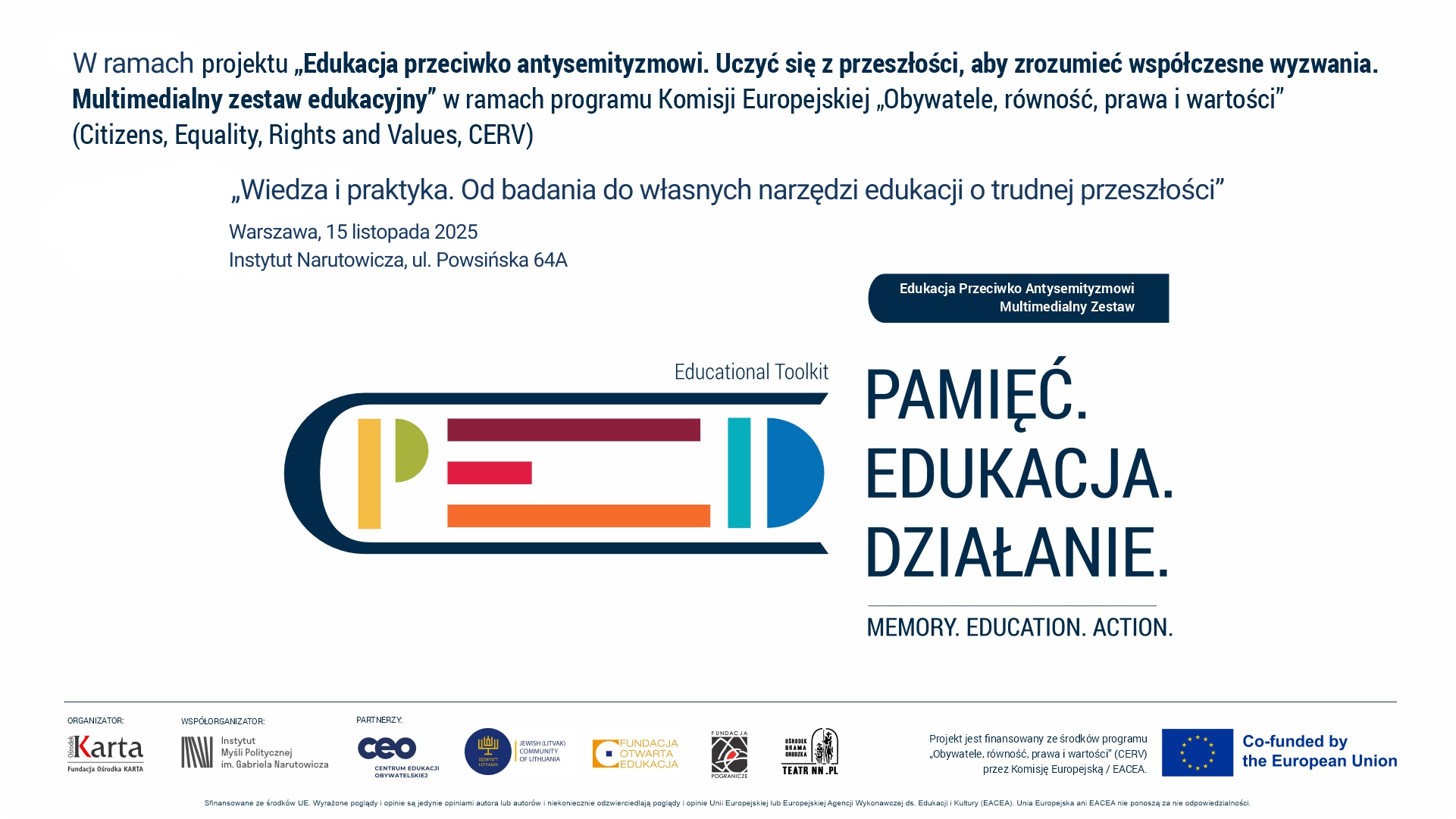
Invitation to event for teachers and experts
We invite you to an event entitled “Knowledge and practice. From research to our own tools for teaching about the difficult past,” during which we will not only present the results of a survey examining the emotional and didactic needs in teaching about the Holocaust, but also discuss ideas for new educational tools and materials that address difficult topics, which takes place in Warsaw on November, 15, from 11 a.m. till 5 p.m. The number of places is limited.
We invite you to an event entitled “Knowledge and practice. From research to our own tools for teaching about the difficult past,” during which we will not only present the results of a survey examining the emotional and didactic needs in teaching about the Holocaust, but also discuss ideas for new educational tools and materials that address difficult topics.
We invite researchers, teachers of history, Polish language, ethics, and civic education, as well as educators from non-governmental organizations and museum guides.
The difficult past is present not only in textbooks, but also in discussions about contemporary challenges, such as the war in Ukraine or Gaza. That is why we propose a joint reflection on these issues:
how to educate not only the “head” but also the “heart,” and what are the consequences of this? How to deal with the emotions that these topics evoke? What do the accounts of witnesses inspire us to do? How did they cope with trauma and how do they cope with it now? How does today’s psychology help us in this matter?
How can we shape critical thinking in students in the age of ubiquitous artificial intelligence? How can we talk about disinformation?
How can teaching about a difficult past influence the formation of civic attitudes? What skills should be developed to recognize prejudice and stereotypes? What is worth making students/class participants aware of? What mechanisms are worth showing?
We invite you to participate and discuss!
The number of places for the event is limited, and participants will be accepted on a first-come, first-served basis.
Event title: “Knowledge and practice. From research to your own tools for teaching about difficult pasts”
Date: November 15, 2025, hours: 11:00 a.m.–4:45 p.m. Venue: Gabriel Narutowicz Institute of Political Thought, Warsaw, ul. Powsińska 64A.
The event is part of the project “Education against anti-Semitism. Learning from the past to understand contemporary challenges. Multimedia educational kit,” and therefore focuses on sample educational materials, which will be published in their final version in the first half of 2026. The event is co-hosted by the Center for Citizenship Education.
Registration link: CLICK HERE.
Event schedule:
11:00–11:30 a.m. – Organizational matters, registration, and welcome coffee
11:30–11:40 a.m. – Welcome and presentation of the program
11:40 a.m.–12:25 p.m. – Presentation of the report from the survey examining emotional and didactic needs in teaching about the Holocaust (Center for Research on Prejudice, University of Warsaw)
12:30–2:00 p.m. – Workshop: Attitudes and choices in extreme times. New educational materials for the exhibition “They Were Neighbors” (led by the Center for Civic Education)
2:00–2:45 p.m. – Lunch break
2:45–3:15 p.m. – Introduction to the presentation of the concept of planned educational materials in working groups (general presentation by KARTA)
3:15–4:15 p.m. – Work in 4 groups (one round): during the group session, participants will be divided into groups addressed to primary and secondary school teachers. These groups will focus on the following topics (to choose from):
- History from a child’s perspective: How to teach about the Holocaust through Larissa Cain’s testimony “The Girl from the Closed City” (led by Małgorzata Glinka) – aimed mainly at primary school teachers.
- Dialogue with an eyewitness: The mechanisms of the Holocaust and contemporary challenges. Between asking questions and searching for answers based on Hedi Fried’s publication “Was I afraid of death? Questions about the Holocaust” (Robert Szuchta) – aimed mainly at secondary school teachers and extracurricular educators.
- Voices from the past – Jewish accounts of Poles’ attitudes towards Jews in local history. Using historical sources and interactive maps as tools for analyzing attitudes and social memory (Mariusz Sokołowski) – addressed mainly to primary school teachers.
- History happened here. Discovering the local context of the Holocaust through the accounts and memories of witnesses (Marek Kołcon) – addressed mainly to secondary school teachers and extracurricular educators.
4:15–4:45 p.m. – Plenary meeting – summary of group work and plans for the future.
Detailed description of workshops you can find here: Invitation and workshop description in English.
Confirmation of participation:
Please confirm your intention to take advantage of your guaranteed place as soon as possible.
To confirm, please complete this survey, including answering the question about your choice of working group (1, 2, 3, or 4), as soon as possible.
If you have any questions, please contact us: phone: +48 22 848 07 12 or e-mail: [email protected]
Financed by the EU. The views and opinions expressed are solely those of the author(s) and do not necessarily reflect those of the European Union or the European Executive Agency for Education and Culture (EACEA). Neither the European Union nor the EACEA is responsible for them.

Hasła z glosariusza
Lecture and presentation of the project – recording
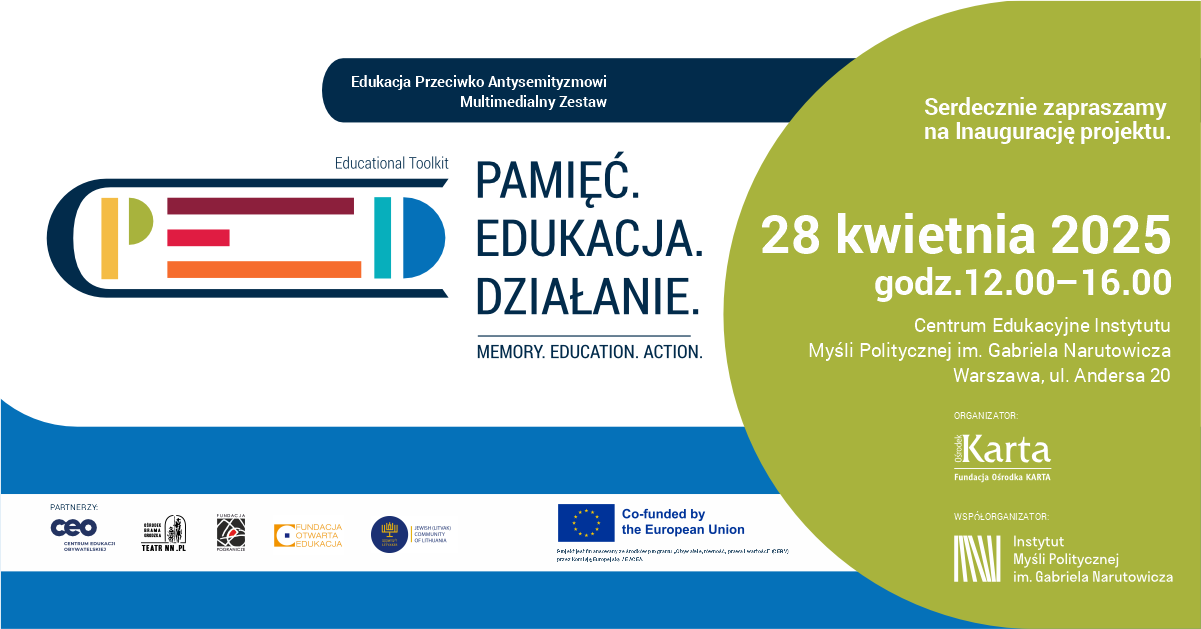
We are posting a report on the official inauguration of the two-year international project “Education Against Anti-Semitism. Learning from the past to understand contemporary challenges. Multimedia Educational Toolkit“ (”Educational Toolkit”). The project will include workshops and training for teachers, educators and students based on a set of new educational materials. When: April 28, 2025, 12:00 […]
We are posting a report on the official inauguration of the two-year international project “Education Against Anti-Semitism. Learning from the past to understand contemporary challenges. Multimedia Educational Toolkit“ (”Educational Toolkit”). The project will include workshops and training for teachers, educators and students based on a set of new educational materials. When: April 28, 2025, 12:00 – 16:00 p.m.; Where: Educational Center of the Gabriel Narutowicz Institute of Political Thought (Warsaw, 20 Wladyslaw Andersa St.).
Hasła z glosariusza
ONLINE-SYMPOSIUM / digital // memory, 30 September 2020
“How can educational institutions, museums, memorial sites and civil society organizations preserve memory in a digital age? What kinds of digital tools can successfully engage an audience and also teach about history? These and other questions will be at the center of our online event on 30 September 2020.”
Invitation to an Online Symposium
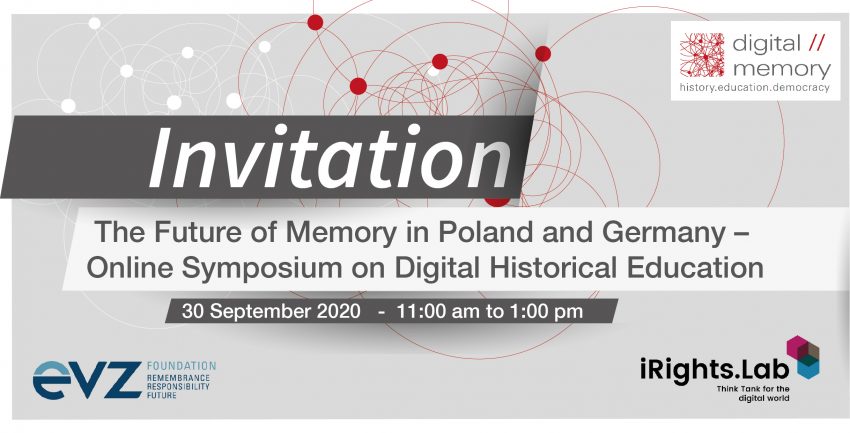
The Future of Memory in Poland and Germany – Online Symposium on Digital Historical Education
30 September 2020, 11 am to 1 pm
Online
How can educational institutions, museums, memorial sites and civil society organizations preserve memory in a digital age? What kinds of digital tools can successfully engage an audience and also teach about history? These and other questions will be at the center of our online event on 30 September 2020.
This symposium is part of the digital // memory program, funded by the EVZ Foundation since autumn 2019. Together with you, we want to celebrate the conclusion of the first year of digital // memory. Join us and our experts to discuss today’s challenges and opportunities of a digital historical-civic education!
Further information about the program and a registration link are here: https://pretix.eu/digitalmemory/symposium/. Please register until 26 September 2020.
Additionally, if you want to stay updated about the event, follow the event’s web page. If you want to learn more about the digital // memory funding program, follow this link.
We look forward to seeing you!
Team EVZ Foundation Team iRights.Lab
#DigitalMemory
Digital History Network – online!
Within the “Teaching History 4.0” project supported by the German Federal Foreign Office, IBB Minsk and IBB Dortmund have launched a Digital History Network and invite your organisation to join! What is it? It’s a platform for organizations, projects and initiatives using digital media and innovative IT solutions for analyzing historical events, conducting research, visualizing […]
Within the “Teaching History 4.0” project supported by the German Federal Foreign Office, IBB Minsk and IBB Dortmund have launched a Digital History Network and invite your organisation to join!
What is it?
It’s a platform for organizations, projects and initiatives using digital media and innovative IT solutions for analyzing historical events, conducting research, visualizing and representing data related to the past.
For whom?
It will be of use to historians, journalists, NGO representatives, history teachers, IT experts, designers and project managers, interested in developing a culture of remembrance in Europe, especially about World War Two events.
How does it work?
A short description about the platform is available here.
The Digital History Network encourages you to join the platform, as we are set to accumulate the best practices and success cases of digital history projects in one place. Apart from adding your organisation and projects, you can also post announcements of events and educational opportunities.
Please feel free to contact Lera Filipyeva, if you have any questions about the platform.
Contact: [email protected]
IBB Minsk, Lera Filipyeva
Youth conference: The Good Human or the Human Good – Footprints of Modern Slavery
The Europeans For Peace is happy to announce that the 2nd EUROPEANS FOR PEACE youth conference will be under the claim The Good Human or the Human Good – Footprints of Modern Slavery. After last years‘ theme „Right here, right now: Human rights“ we want to gain a deeper insight on Article 4 of the European […]
The Europeans For Peace is happy to announce that the 2nd EUROPEANS FOR PEACE youth conference will be under the claim The Good Human or the Human Good – Footprints of Modern Slavery. After last years‘ theme „Right here, right now: Human rights“ we want to gain a deeper insight on Article 4 of the European Convention on Human Rights: „No one shall be held in slavery or servitude.“
This Article explicitly declares the prohibition of slavery and forced labor. This makes slavery officially illegal, but there are still numerous people worldwide living under conditions where they are being forced to work, facing threats and violence against them or their families. This youth conference will focus on this human rights violation, providing an overview not only of the history of the slavery and our colonial backpack but also of the current global situation.
What is our responsibility as active Europeans and global citizens? During the EUROPEANS FOR PEACE with workshops and discussions held by experts who champion human rights, we want to develop strategies for sustainable action and searching for concepts for a society where everyone is treated fairly and equally.
The event is organized jointly by the wannseeFORUM and the EVZ Foundation. Register now under www.youforpeace.org!
Also, join the Facebook event to stay updated: https://www.facebook.com/events/640010563160447/
If any questions remain, please don’t hesitate to ask.
Please inform interested young people about the youth conference.