Invitation to event for teachers and experts
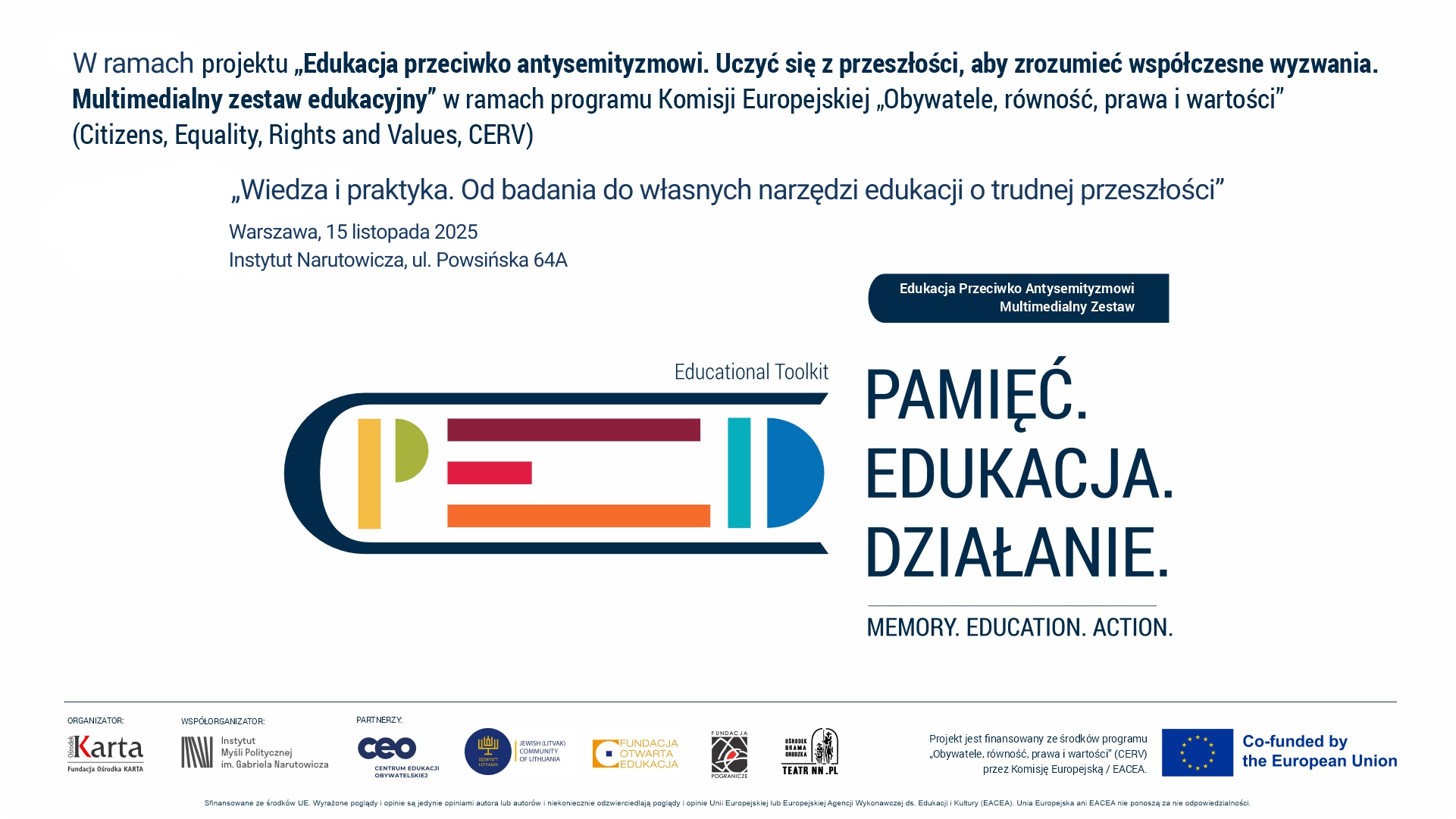
We invite you to an event entitled “Knowledge and practice. From research to our own tools for teaching about the difficult past,” during which we will not only present the results of a survey examining the emotional and didactic needs in teaching about the Holocaust, but also discuss ideas for new educational tools and materials that address difficult topics, which takes place in Warsaw on November, 15, from 11 a.m. till 5 p.m. The number of places is limited.
We invite you to an event entitled “Knowledge and practice. From research to our own tools for teaching about the difficult past,” during which we will not only present the results of a survey examining the emotional and didactic needs in teaching about the Holocaust, but also discuss ideas for new educational tools and materials that address difficult topics.
We invite researchers, teachers of history, Polish language, ethics, and civic education, as well as educators from non-governmental organizations and museum guides.
The difficult past is present not only in textbooks, but also in discussions about contemporary challenges, such as the war in Ukraine or Gaza. That is why we propose a joint reflection on these issues:
how to educate not only the “head” but also the “heart,” and what are the consequences of this? How to deal with the emotions that these topics evoke? What do the accounts of witnesses inspire us to do? How did they cope with trauma and how do they cope with it now? How does today’s psychology help us in this matter?
How can we shape critical thinking in students in the age of ubiquitous artificial intelligence? How can we talk about disinformation?
How can teaching about a difficult past influence the formation of civic attitudes? What skills should be developed to recognize prejudice and stereotypes? What is worth making students/class participants aware of? What mechanisms are worth showing?
We invite you to participate and discuss!
The number of places for the event is limited, and participants will be accepted on a first-come, first-served basis.
Event title: “Knowledge and practice. From research to your own tools for teaching about difficult pasts”
Date: November 15, 2025, hours: 11:00 a.m.–4:45 p.m. Venue: Gabriel Narutowicz Institute of Political Thought, Warsaw, ul. Powsińska 64A.
The event is part of the project “Education against anti-Semitism. Learning from the past to understand contemporary challenges. Multimedia educational kit,” and therefore focuses on sample educational materials, which will be published in their final version in the first half of 2026. The event is co-hosted by the Center for Citizenship Education.
Registration link: CLICK HERE.
Event schedule:
11:00–11:30 a.m. – Organizational matters, registration, and welcome coffee
11:30–11:40 a.m. – Welcome and presentation of the program
11:40 a.m.–12:25 p.m. – Presentation of the report from the survey examining emotional and didactic needs in teaching about the Holocaust (Center for Research on Prejudice, University of Warsaw)
12:30–2:00 p.m. – Workshop: Attitudes and choices in extreme times. New educational materials for the exhibition “They Were Neighbors” (led by the Center for Civic Education)
2:00–2:45 p.m. – Lunch break
2:45–3:15 p.m. – Introduction to the presentation of the concept of planned educational materials in working groups (general presentation by KARTA)
3:15–4:15 p.m. – Work in 4 groups (one round): during the group session, participants will be divided into groups addressed to primary and secondary school teachers. These groups will focus on the following topics (to choose from):
- History from a child’s perspective: How to teach about the Holocaust through Larissa Cain’s testimony “The Girl from the Closed City” (led by Małgorzata Glinka) – aimed mainly at primary school teachers.
- Dialogue with an eyewitness: The mechanisms of the Holocaust and contemporary challenges. Between asking questions and searching for answers based on Hedi Fried’s publication “Was I afraid of death? Questions about the Holocaust” (Robert Szuchta) – aimed mainly at secondary school teachers and extracurricular educators.
- Voices from the past – Jewish accounts of Poles’ attitudes towards Jews in local history. Using historical sources and interactive maps as tools for analyzing attitudes and social memory (Mariusz Sokołowski) – addressed mainly to primary school teachers.
- History happened here. Discovering the local context of the Holocaust through the accounts and memories of witnesses (Marek Kołcon) – addressed mainly to secondary school teachers and extracurricular educators.
4:15–4:45 p.m. – Plenary meeting – summary of group work and plans for the future.
Detailed description of workshops you can find here: Invitation and workshop description in English.
Confirmation of participation:
Please confirm your intention to take advantage of your guaranteed place as soon as possible.
To confirm, please complete this survey, including answering the question about your choice of working group (1, 2, 3, or 4), as soon as possible.
If you have any questions, please contact us: phone: +48 22 848 07 12 or e-mail: [email protected]
Financed by the EU. The views and opinions expressed are solely those of the author(s) and do not necessarily reflect those of the European Union or the European Executive Agency for Education and Culture (EACEA). Neither the European Union nor the EACEA is responsible for them.